Become one of global market leading countries, establish an industry academia
collaboration environment for future air traffic paradigm shift by UAM HRD
More than 75 Experts, Employment rate 80% above
Train hands-on experienced experts (M.S., Ph.D.) and develop related projects
Strategies
01
Set up professional curriculum for UAM industrial group and involved universities
02
Train 15 experts (M.S., Ph.D.)
every year based on
UAM project
03
Industry academia collaboration projects considering industrial needs
04
Industrial needs-based
curriculum and projects
for employment
Business Description
1Year
2022
Establish a foundation of UAM HRD
Set up general classes in UAM area
Develop collaborative project with UAM related companies and universities
2Year
2023
Expand a foundation of UAM HRD
Set up major classes in UAM area
Expand UAM consortium
Develop Employment program (mentoring etc.)
3Year
2024
Establish UAM HRD
Set up intensive major classes in UAM area
In-job training, internship
Survey on alumni and share achievements
4Year
2025
Intensify UAM HRD
Educate UAM certification and evaluation standards
Establish UAM employment and start-up environment
Promote campus recruiting and job fair
5Year
2026
Stabilize UAM HRD
Educate on intellectual property rights related to programs and R&D results
Re-establish and stabilize UAM interdisciplinary curriculum
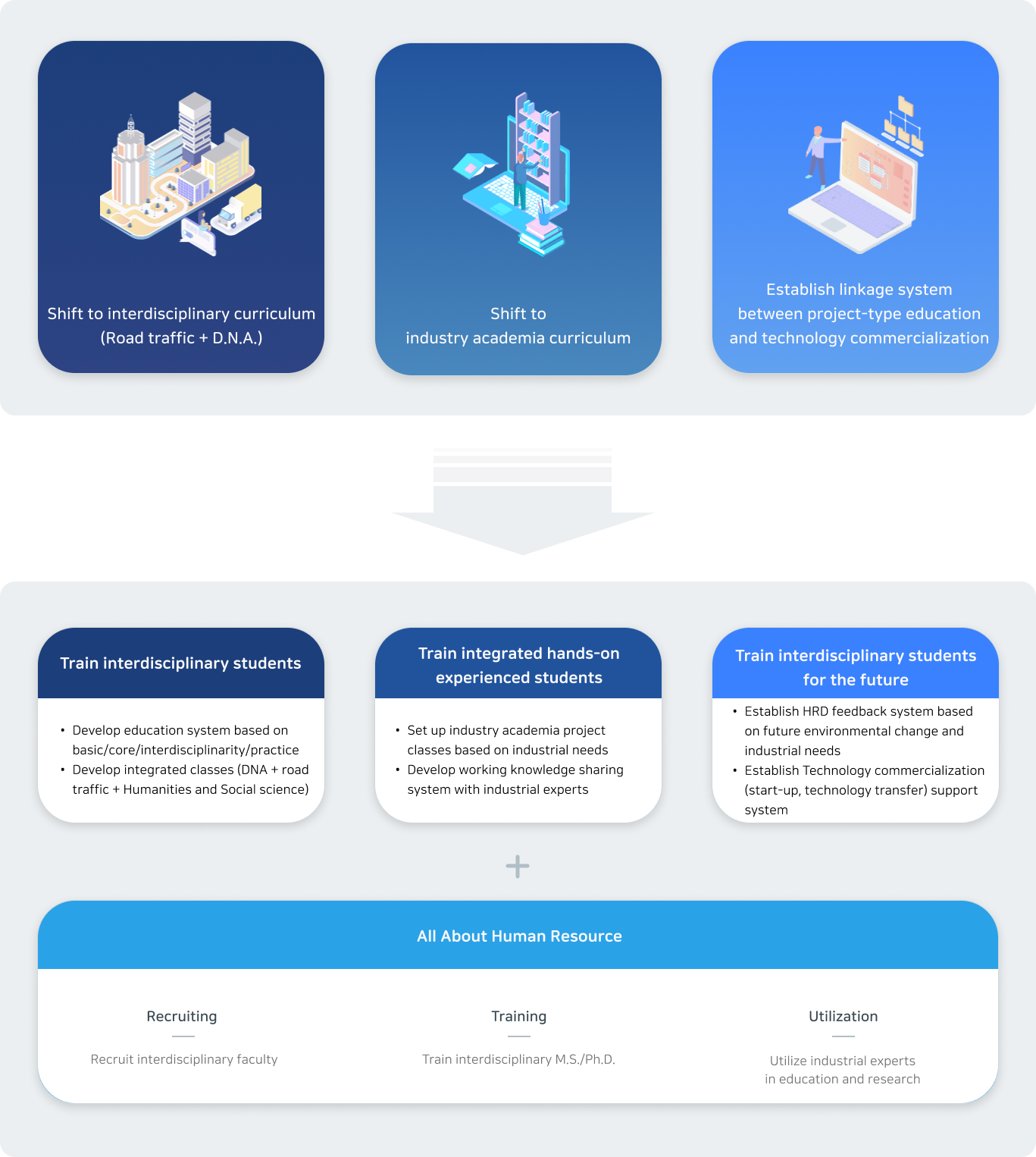
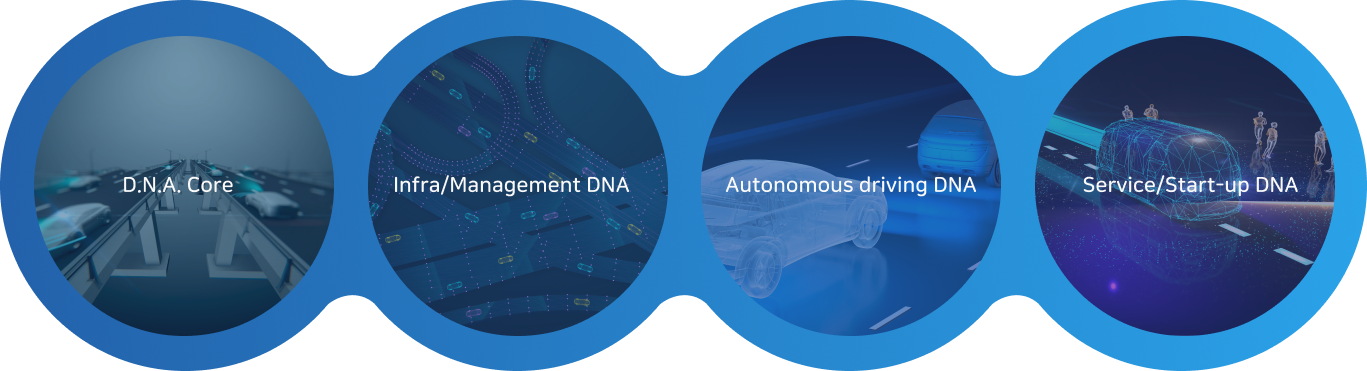
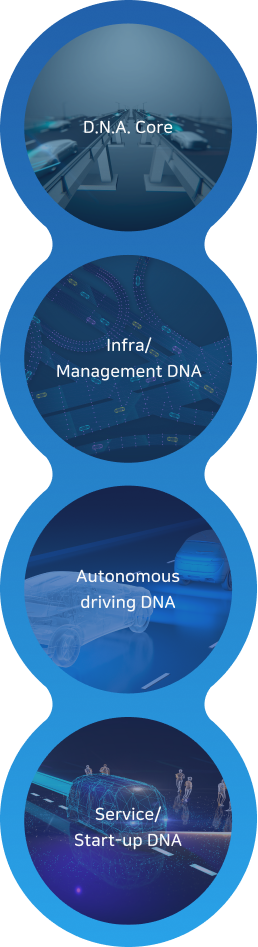
DNA
D.N.A.
Vision
Establish human resource development (HRD) system for the future by adapting road traffic D.N.A. (Data. Network. AI) interdisciplinary curriculum
University needs to change first, which is the start of training professionals
Goal
Strategies
Goal and Strategies
Focused Area
KKRMP
KKRMP (KAIST-KORAIL Railway Standard Mobility Program)
Overview and
Establishment Purpose
Curriculum
Degree Program
Master’s Program (Coursework Master’s Degree Program)
Degree Awarded
Master of Engineering
Student Status
General Scholarship Student
Curriculum
Established and operated as a full-time coursework program of KKRMP in collaboration with participating departments (School of Electrical Engineering, Department of Mechanical Engineering, Department of Civil and Environmental Engineering, Department of Industrial and Systems Engineering, and College of Business/Technology Management)
Education/Research Field
Railway Convergence
Tuition and Research Funding
All direct and indirect education and research expenses are funded by contributions provided by participating companies to KAIST
Student Admission
Recruitment Field
Master’s Program, Cho Chun Shik Graduate School of Mobility, KAIST
Eligibility
Only employees of Korea Railroad Corporation (KORAIL) who have been selected as candidates for academic training dispatch are eligible to apply.(Other eligibility requirements follow the admission criteria for KAIST’s Master’s programs.)
Application Method
– Apply through the internal recruitment process of KORAIL
– Apply for admission to the KAIST Master’s program